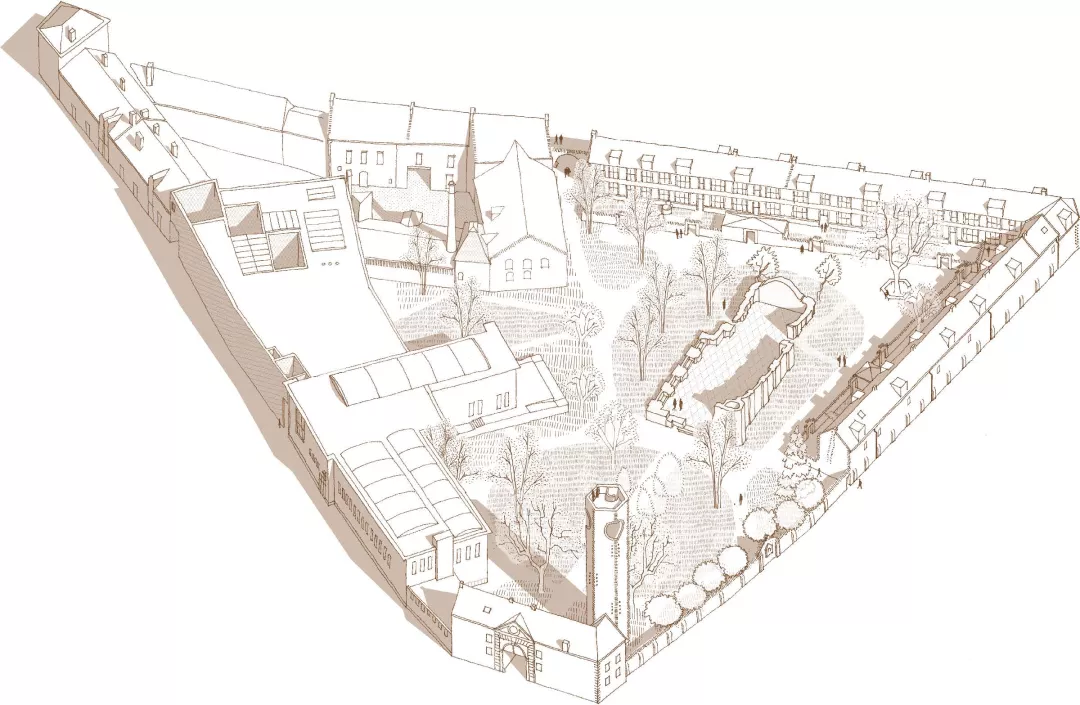
Reconstruction drawings — Joshua Kempen, Genius Loci research seminar (led by Koenraad Van Cleempoel), Faculty of Architecture and Art, UHasselt, 2025
A beguinage in motion
In 2025, the restored beguinage will once again swing open its gates. The project, commissioned by the Province of Limburg and designed by Bovenbouw Architecture (BE) and David Kohn Architects (UK), goes far beyond the mere restoration of the beguinage houses. A new contemporary tower, open to visitors, restores the prominence the complex once had in the Hasselt skyline.
Today, the church ruins serve as a square and meeting place. Now home to UHasselt's Faculty of Architecture and Art, the beguinage houses breathe creativity and knowledge once more. A second passage has now been carved through what was once a fully walled enclosure with just a single gate, allowing the beguinage to become to new green heart of Hasselt, nestled between the renovated Z33 and the Jenever Museum

The beguinage around 1780
Between 1707 and 1763, the beguines build houses on the left bank (right in the drawing) of the Nieuwe Demer river. In 1754, a grand baroque church rises at the heart of their walled court. A small gate in the wall allows people to come and go.
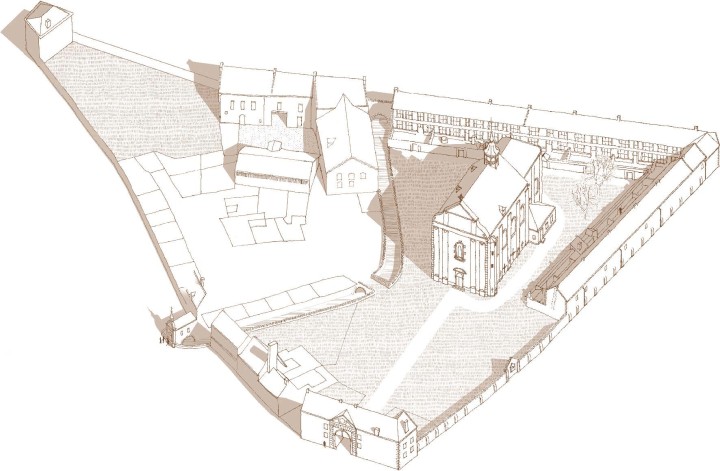
The beguinage around 1842
In 1780, a stately gatehouse is added to the beguinage, perfectly in line with the nave of the church. The beguinage is now complete. After the French Revolution, the right bank in particular is repurposed in various ways, becoming a monastery, a school for boys, and an orphanage. In 1886, the last beguine passes away.
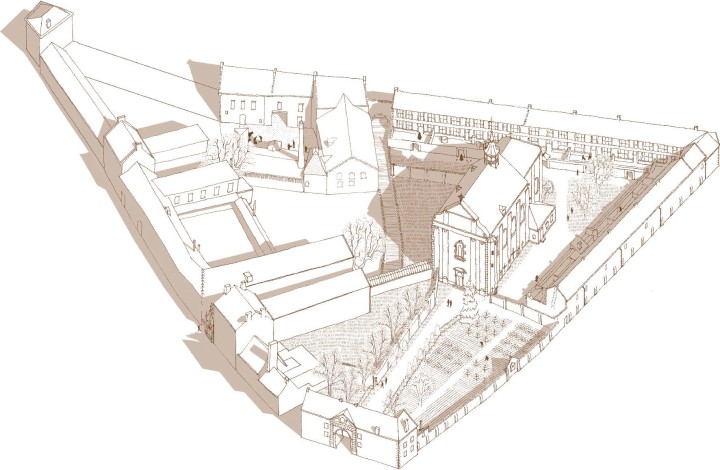
The beguinage around 1900
In 1885, the Brothers of Charity take over the school. Between their school and the beguinage church, they build a covered gallery. In 1939, one year after the Province of Limburg takes over the site, the the beguinage becomes a listed building. In 1944, during World War II, a bombing raid completely devastates the church.

The beguinage around 1958
After the war, the bombed-out church remains in ruins, but the Province of Limburg restores the houses. In 1946, the Provincial Library of Limburg opens its doors. Inspired by Expo 58, the Province builds a new venue for contemporary art. This would morph into Z33 later down the line. Artist studios are set up in some of the houses.
The first beguinage outside the walls
In the second half of the 13th century, Hasselt grows into a prominent city, enclosed by a wall from 1280 onwards. Outside of those walls, beguines have been living in a small beguinage since before 1245. In 1567, violence breaks out in Hasselt. Protestant 'iconoclasts' destroy statues of saints and ornaments in Hasselt's churches, monasteries and chapels. The beguinage is not spared either.
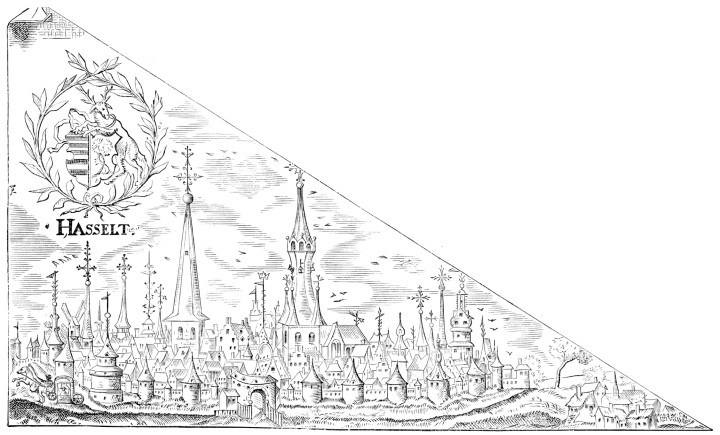
17th-century pilgrim's pennant belonging to Niklaas Sigers (taken from BRUYLANT E., La Belgique illustrée, 1890).
The old court in the city
The beguines start from scratch. In 1571, they move into the centre of Hasselt, where they already own land. They build a new church there in 1573. As their community starts to expand, they buy up land along the Nieuwe Demer river from 1616 onward. In the early 18th century, they build the third beguinage — the one you find yourself in today — on the left bank of that river.

Map of the City of Hasselt, c. 1730 Art Collection of the Province of Limburg
