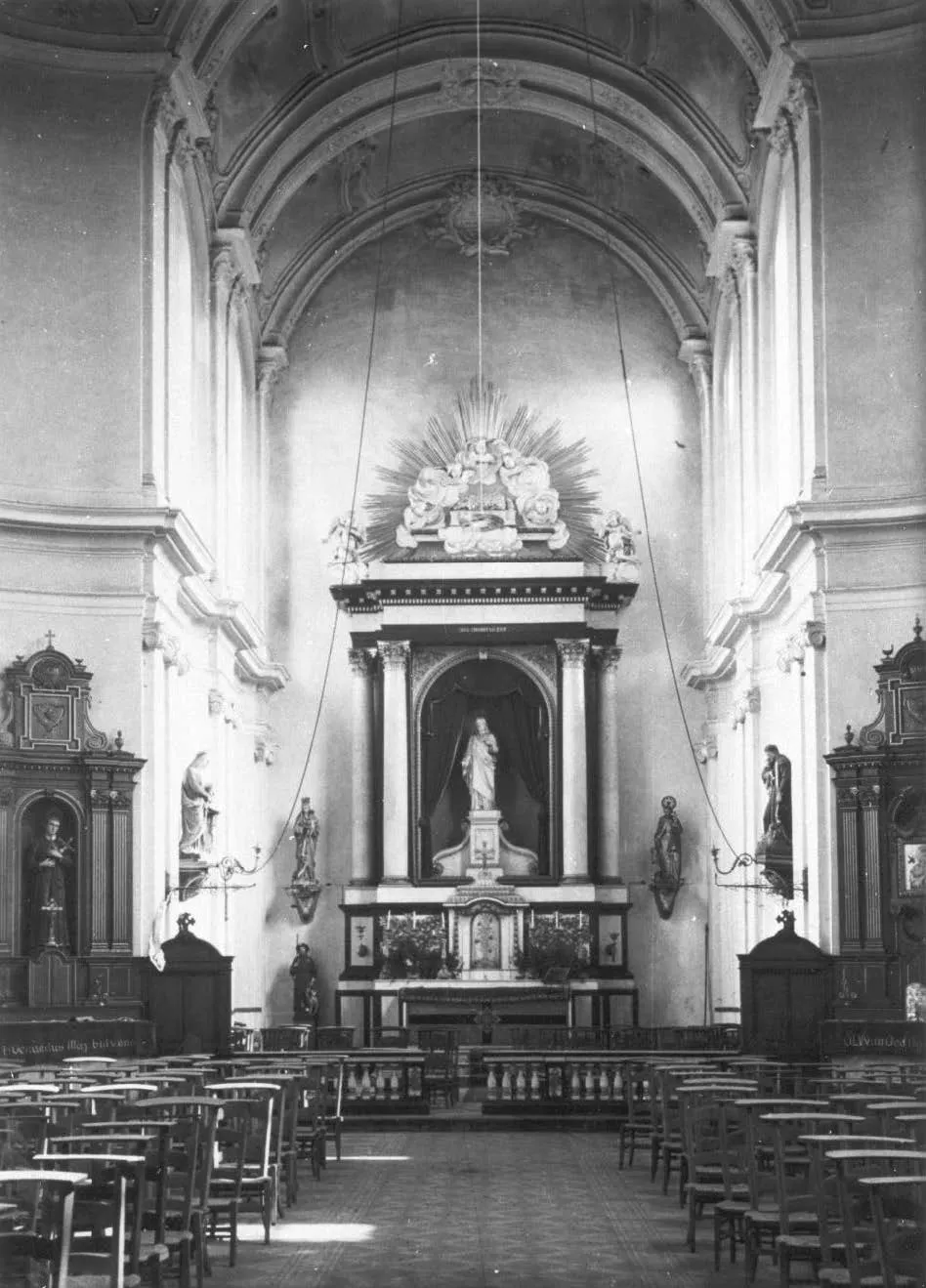
Interior of the former beguinage church. On the night of 11 to 12 May 1944, the beguinage church is reduced to rubble by a stray bomb. (KIK/IRPA, General Commissioner's Office for Reconstruction, 1943)
A beguine with a plan
Between 1707 and 1763, the beguines and the court mistresses dedicated to their cause build thirteen houses around a central square. An impressive baroque church is added to the complex in 1754, followed by this stately gatehouse in 1780. The beguines had to follow the orders of their court mistress, who usually came from a wealthy Hasselt family. It is to one of them — Anna Margaretha van Hilst — that the beguines owe their church. She is the woman in the painting in this room. Van Hilst is a strong-willed, ambitious and well-to-do court mistress with a plan. She persuades the city and the diocese that the beguines deserve a church right at the heart of their new site.
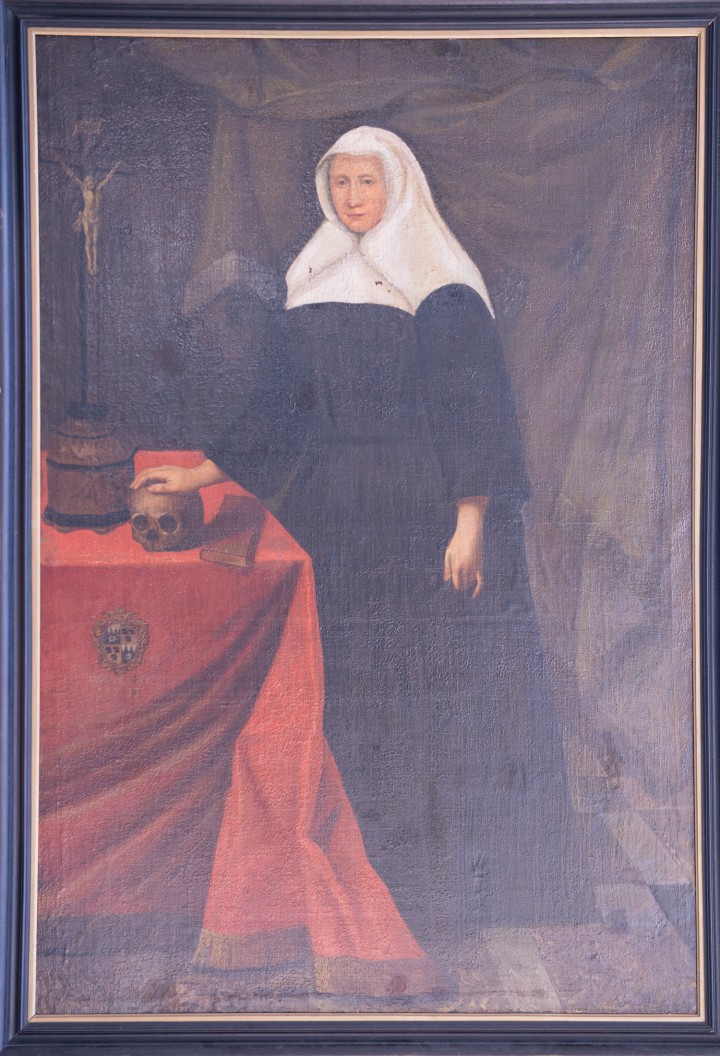
Portrait of Anna Margaretha van Hilst
Anonymous painter – 1737, oil on canvas (Art Collection of the Province of Limburg)
Anna Margaretha van Hilst (1689–1763) became headmistress of the Beguinage of Hasselt in 1742. In 1754, she commissioned the construction of the Beguinage church, which was consecrated in 1758.
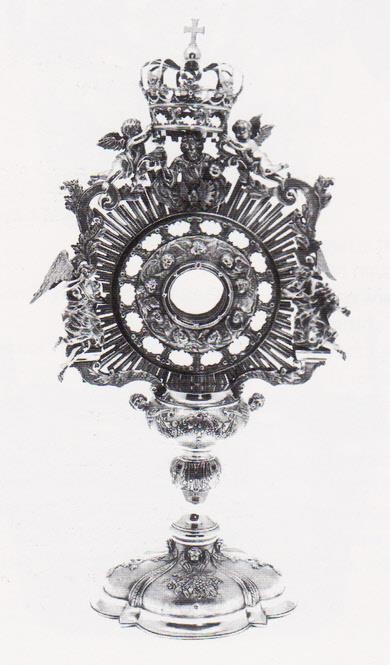
Monstrance
Jan Frans Frederici – 1736, Silver (Art Collection of the Province of Limburg, on loan from the Missionaries of Africa)
Anna Margaretha van Hilst commissioned this monstrance from the Hasselt goldsmith Jan Frans Frederici to display the Holy communion wafer. The inscription on the back reads: “DLLA ANNA MARGARETHA VAN HILST BEGINA HASSELENSIS”.
Van Hilst's Dream, from needle to thread.
Eva De Hovre - Tactile tableau of the Hasselt Beguinage in the 18th century - 2026, yarn, linen, thread.
Feel free to gently touch the planes and lines of this tactile tableau. It depicts daily life in the Hasselt Beguinage at its peak in the 18th century. Eva De Hovre embroidered this tableau using a needle, thread and hand-woven fabrics in linen and wool. The materials and techniques used reference the beguinage. Manual tasks such as spinning wool and washing and bleaching cloth in and around the Demer river were part of the everyday routines of the Beguines.
Eva De Hovre (1987, Ghent) is an illustrator, lecturer and architect. The images she creates reflect her love of the analogue. She wanders intuitively between subjects and techniques, often using her everyday life and surroundings as a starting point. With a keen eye for detail, she creates both personal work and commissioned projects.